Showing posts with label German. Show all posts

Friday, May 27, 2016

Young Germans prefer Netflix

81% of Germans between 14 and 34 years of age use video-on-demand (VOD) services.
The most popular VOD provider is Netflix with a market share of 39%, followed by Amazon Prime Instant Video (36%), according to a survey by market research company Appinio among 5,488 Germans from 14 to 34 years of age. iTunes (23%), Sky Online (21%), maxdome (17%), Watchever (6%) and Videoload (3%) follow.
The selection of the two most popular VOD services differs regarding age: In the 20-24 age group, nearly one in two (48%) have opted for Netflix while less than a third (30%) of people above 30 years of age use it. The opposite is the case with Amazon Prime Instant Video: 30% of people between 14 and 19 years of age use it, rising to 39% in the 30-34 age group.
The largest part of the users watch VOD services through a TV set (57%). Nearly one in two (49%) use a smartphone followed by a desktop-PC (39%) and a tablet (32%).
The most important reason for signing up for a VOD service is the line-up of current movies and series, followed by an extensive movie library and a large series stock. Personal film recommendations and original-language content are less important, ranked 4 and 5.

Sunday, April 5, 2015

German Cartel Office approves DVB-T2 encryption

The Bundeskartellamt in Bonn
The Federal German Cartel Office Bundeskartellamt has given the green light to the plans by transmitter network operator Media Broadcast to set up a subscription-based DTT platform for commercial TV channels as part of the transition from broadcast standard DVB-T to successor DVB-T2, arguing that it would not limit competition.
“The business relationship between such a platform operator and the broadcast groups has to be created in compliance with the cartel law. In separate negotiations with the commercial broadcasters, Media Broadcast has worked out individual contracts for the fee-based provision of the channels. In this respect, there has been no act limiting competition,” Andreas Mundt, president of the Cartel Office, said in Bonn.
Media BroadcastThe DVB-T2 platform for which Media Broadcast has been selected as the operator by the media authorities will contain HD channels from the two major commercial broadcast groups RTL and ProSiebenSat.1 as well as further commercial channels in SD and HD quality. The encrypted channels will be offered to consumers for a subscription fee. The public broadcasters’ channels will, however, continue to be provided unencrypted and free of charge.
The creation of a fee-based platform has been an autonomous corporate decision by Media Broadcast, according to the Cartel Office. The authority explains that, according to its conclusions, the participating broadcasters have autonomously and independently from each other determined whether they will provide their channels to Media Broadcast for distribution on the platform and individually set the conditions.
The Cartel Office, thus, judges this case different from the dispute regarding the encryption of the SD channels on cable, satellite and IPTV in which the authority imposed a total fine of €55 million against RTL and ProSiebenSat.1 for anticompetitive agreements.

Thursday, September 11, 2014

Analogue TV caught up in German cable

Digitalisierungsbericht 2014More than one third (37%) of cable customers in Germany still solely watch analogue television, resembling 6.2 million households, according to the digitalisation report 2014 released by the German media authorities.
In particular older citizens and low-income households are among the analogue TV users. 11.2 million of the 17.9 million cable households now use digital TV, corresponding with a share of 63% (2013: 56%). More than 3 million cable customers have signed up for the HD versions of the commercial free-to-air channels which are offered for an additional monthly subscription fee.
In total, the digital TV share among the German TV households now amounts to 84% (2013: 81%). All of the analogue households are cable subscribers as that’s the last infrastructure still offering analogue television.
The reach of the different distribution infrastructures remains almost unchanged. Each holding a share of slightly over 46% of the TV households, cable and satellite remain in the top positions. DTT slightly dropped from 11% to 10% of the TV households. In total, 3.9 million households receive DTT of which 2 million use DTT as their sole TV reception method.
DTT is particularly popular in regions in which both public and commercial TV channels are offered with the reach climbing to 17% of the TV households in these areas. If DTT reception via PCs, laptops, smartphones, tablets and TV receivers in cars is included, the reach rises to 26%.
IPTV remains unchanged at 5% of the TV households, corresponding with 1.9 million households.
45% of the German population now watches video content through the internet. 22% do this using a connected TV set hooked up to the internet (Smart TV). 23% of the TV households have an internet-capable TV set, an increase by 46% compared with last year.
15% of the households have connected their TV set directly or indirectly – for example through a set-top-box or a games console – to the internet, corresponding with 5.7 million households. Video consumption through the internet is on the rise mainly on Smart TV sets (+61%) and on tablets (+88%).
Most video-on-demand (VOD) consumers (58%) use the public and commercial broadcasters’ catch-up TV portals (Mediatheken) followed by video portals (25%) and online video stores (21%) such as maxdome, Watchever and Amazon Instant Video.
43% of the TV viewers use a second screen in parallel to TV consumption, for example a smartphone, laptop or tablet. E-Mail and instant messaging (72%) are most used during TV consumption, followed by current news and information (59%) and social networks (51%). Only 27% of the second screen users access content accompanying the TV programme they are currently watching.
For many users, the second screen is in fact already the first screen. Asked which screen they devote most of their attention to during parallel usage, 38% say it’s their smartphone, tablet or laptop. 35% still mainly follow the happenings on the TV screen.
For the digitalisation report 2014, market research company TNS Infratest interviewed more than 6,000 people representing the characteristics of the German population. The study can be downloaded in both German and English-language free of charge in PDF format on the media authorities’ website.

Monday, August 18, 2014

Germans embrace TV sets despite mobile boom

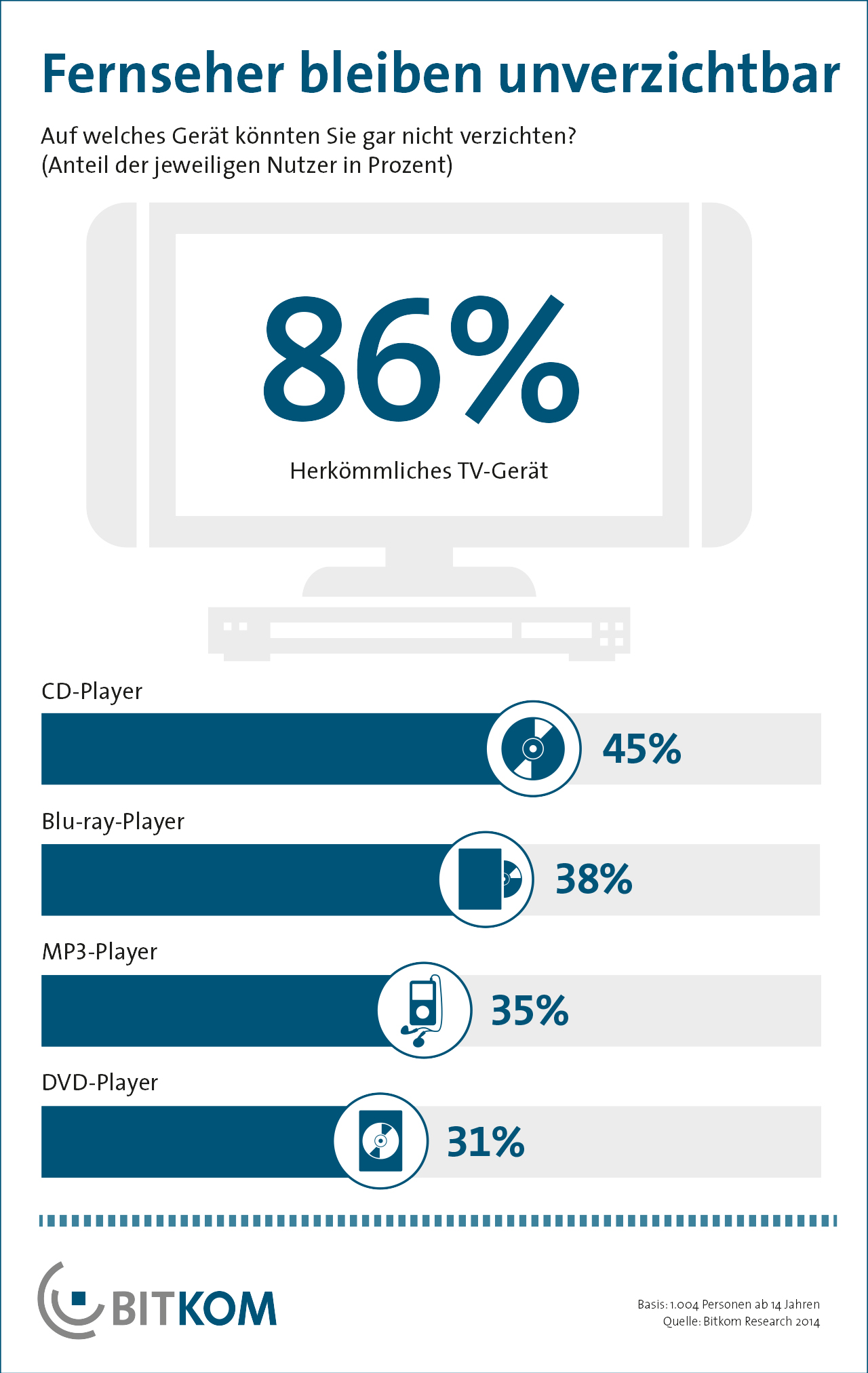
140812_unverzichtbares CE-GerätThe TV set stays indispensable for the majority of Germans.
Five out of six TV users (86%) say that they “absolutely can’t” go without their TV set. TV sets are considered to be much more important than other home electronics devices such as CD, MP3 and DVD players (see chart).
These are the results of a survey conducted by research institute Aris among 1,004 people of at least 14 years of age on behalf of industry association BITKOM.
“The trend towards streaming on mobile devices like smartphones and tablet computers complements the TV set, but doesn’t replace it,” BITKOM’s managing director Bernhard Rohleder said in Berlin.
There is not much difference between age groups: Even 87% of TV users between 14 and 29 years of age say that they consider their TV set to be indispensable.
There are plenty of different ways to use TV sets nowadays besides the consumption of linear television, DVDs or Blu-ray discs. For example, photo and video files from the computer can be viewed on the TV screen.
According to research by IHS Technology, around 29 million TV sets are connected to the internet in Germany enabling direct streaming of TV programmes and videos from the web. “The TV set increasingly turns into a general output device for all kinds of sounds and images,” said Rohleder.

Friday, August 15, 2014

Germans embrace TV sets despite mobile boom

140812_unverzichtbares CE-GerätThe TV set stays indispensable for the majority of Germans.
Five out of six TV users (86%) say that they “absolutely can’t” go without their TV set. TV sets are considered to be much more important than other home electronics devices such as CD, MP3 and DVD players (see chart).
These are the results of a survey conducted by research institute Aris among 1,004 people of at least 14 years of age on behalf of industry association BITKOM.
“The trend towards streaming on mobile devices like smartphones and tablet computers complements the TV set, but doesn’t replace it,” BITKOM’s managing director Bernhard Rohleder said in Berlin.
There is not much difference between age groups: Even 87% of TV users between 14 and 29 years of age say that they consider their TV set to be indispensable.
There are plenty of different ways to use TV sets nowadays besides the consumption of linear television, DVDs or Blu-ray discs. For example, photo and video files from the computer can be viewed on the TV screen.
According to research by IHS Technology, around 29 million TV sets are connected to the internet in Germany enabling direct streaming of TV programmes and videos from the web. “The TV set increasingly turns into a general output device for all kinds of sounds and images,” said Rohleder.

Saturday, August 9, 2014

40 million Germans use video-streaming

German consumers mainly watch videos on the internet in streaming mode.
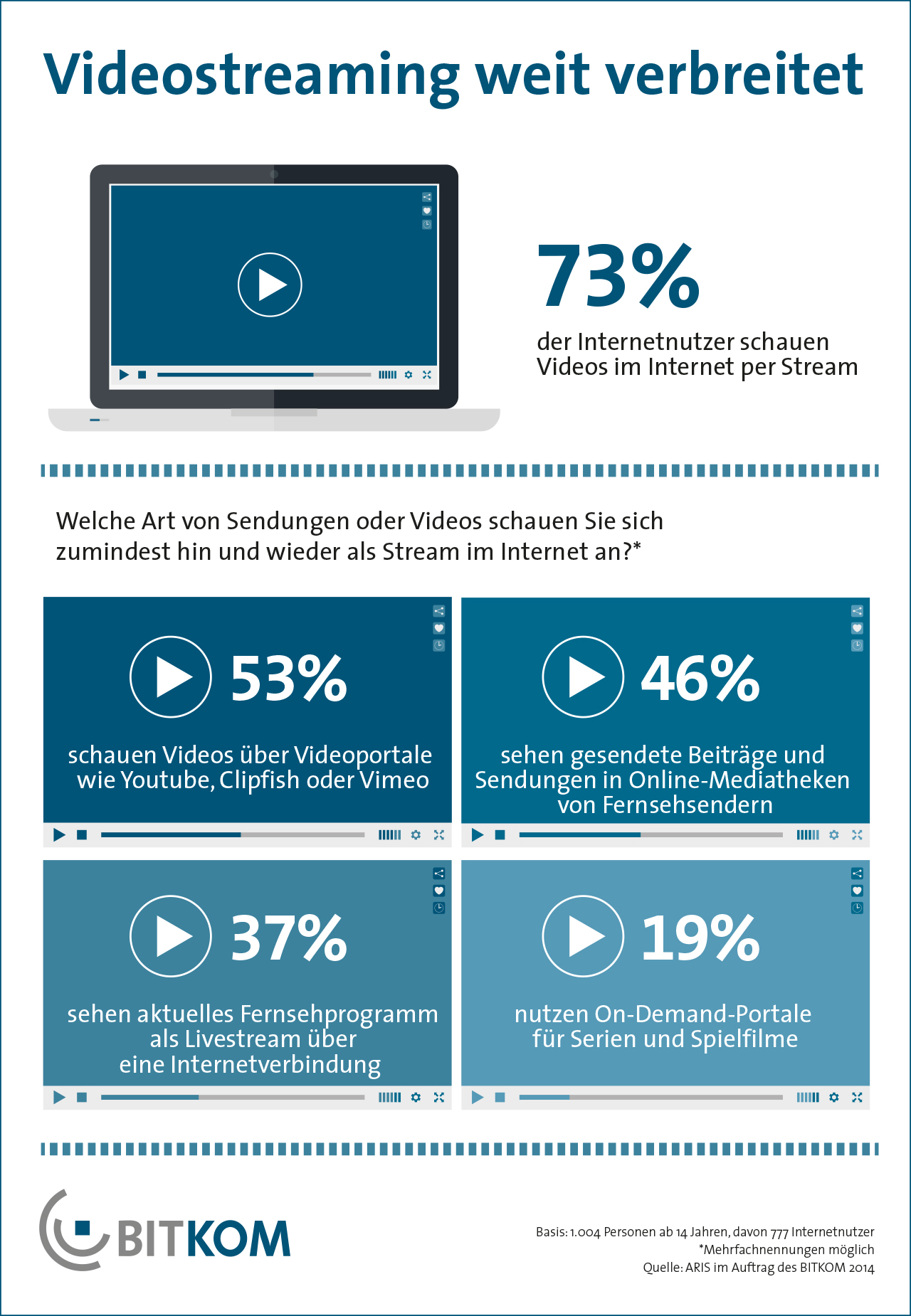
140701_TelefonieThree out of four internet users (73%) from 14 years of age use video-streams. This corresponds with more than 40 million Germans, according to a survey research institute Aris conducted among 1,004 people from 14 years of age for German industry association BITKOM.
Only every fourth internet user (27%) downloads and saves videos to watch them at a later stage.
Video portals are the most popular destination. More than half (53%) of internet users watch videos on platforms like YouTube, Clipfish, MyVideo or Vimeo. Almost every second one (46%) uses TV broadcasters’ catch-up services to watch programmes they missed.
More than one third (37%) of internet users occasionally watch a linear TV channel as a live-stream on the internet. Every fifth (19%) uses video-on-demand (VOD) portals for movies and series like maxdome, Watchever, Amazon Prime Instant Video or Videoload.
Many streaming users regularly watch videos on the net. Two out of five (40%) do this several times per week, every seventh one (14%) daily. Streaming users prefer free-of-charge video services (78%). Nonetheless, almost every sixth user (17%) has opted to pay for fee-based offerings.